Yes, it's true, I saw Inception (2010) MONTHS ago when it first came out. This is not a new viewing for me. But, it's one of the films nominated for Best Picture this year, and so I think it's unfair to give all the others a chance, and not add one about this film- especially since I've been referencing it with my vote, so far. :P
Inception follows the slightly damaged and dwindling Dom Cobb (Leonardo DiCaprio) and his straight-laced partner, Arthur (Joseph Gordon-Levitt), as Secret Agents who specialize in using a very secret technology- the ability to get into someone's head... literally. This process can only be accomplished while the victim (or client?) is fast asleep and dreaming, and Cobb is the best of the best when it comes to this. Or, he was, until a mysterious woman, Mal (Marion Cotillard), started following him in this process and deliberately sabotaging him. And if that person's sleep is for any reason disrupted, the dream- and the game- is over. Cobb and Arthur are assigned by Mr. Saito (Ken Watanabe) to a very illegal game of espionage on his target Robert Fischer (Cillian Murphy). They must accomplish a task which only Cobb knows is possible, and everyone else doubts: Inception- to place an original idea in the head of another, in order to make them believe they thought of it. Saito guarantees that if they complete this task, he can legally get Cobb back into the USA- where he is banned- and into the arms of the children he hasn't seen in years. They have to go in deepy, dreams within dreams to do so, and Cobb knows they cannot do it on their own. They gather members for their dream team over time, and the youngest of them, still in college, Ariadne (Ellen Page), develops a connection with Cobb- not one of romance as in typical Hollywood glam, but one of curiousity and mind. She uncovers that Mal is actually Cobb's deceased wife, which is the stepping stone sending her on a mission of discovery about realities and dreams, truth and what we merely percieve as truth, as Cobb struggles to relieve himself of his past, and deposit a true original thought into Robert Fischer's brain.
This film was conceived and written and directed by Christopher Nolan, who proudly developed the recent films, The Dark Knight, Memento, and Batman Begins. When he first thought of the concept, ten years ago, he pictured Inception as a horror film. It stands now as an Action/Mystery/Sci-Fi, leaving lingering questions in the minds of its viewers. He remarks that he was influenced by the era that produced The Matrix, Dark City, and The Thirteenth Floor, as well as an Anime film called Paprika. He first pitched this idea back in 2001, but then decided that he wasn't up to par as far as creating big-scaled pieces went, and he then made his marks on the Batman movies. After directing The Dark Knight, he decided it was time, and he spent six months writing the feature-length script. His outline had been 80 pages long. Leonardo DiCaprio was the first actor cast into the film, and Nolan had always wanted to work with him, but never had a role designed that DiCaprio would take. DiCaprio admits that the concept really intrigued him, but that you did have to have Nolan there to be able to actually hear him explain some of the things he'd been working on over the ten year period.
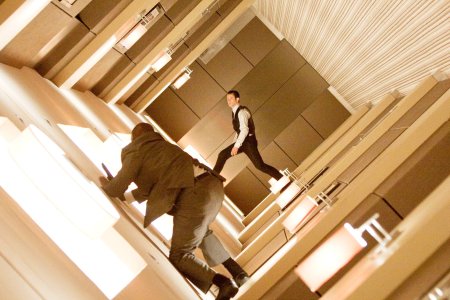
The writing is exceptional in this piece. Not a single detail is left unexplained (unless by intention) or unresolved (unless by intention). The ten years he spent fine-tuning this are clear even on the first watch, when the common viewer picks up only about 1/4 of the detail. It's also remarkably visual and graphic. Because much of the film takes place in dreams, the physical worlds they travel in are incredibly vivid and realistic, and we go from a snowy mountain top to a cafe in Paris, to a van hurdling 100 feet down, into the water. The ground rises to become the sky, objects fly, gravity disappears, and all of it is wrapped up inside fantastic cinematography that shows you exactly what you need to see. The subplots are complex, but don't take away from the A Story at all. Every single part is played as it should have been. Personally, I think it's great when a writer has a chance to direct his own piece, so that his concept can be directly communicated during shooting- as there's only so much you can put in a script.
Hans Zimmer did the music for this movie, and if you know me at all, you know he's my favorite composer. From his work on The Lion King to The Ring to Thelma and Louise to The Dark Knight, this guy has a range. I will say that this music reminds me a lot of the music from The Dark Knight, but slightly more electronic, in a way. It's still wonderfully done, and one of the other things nominated for an Oscar, this year.
Everyone needs to see this movie. And I don't want to hear any more crap about how it's the same damn movie as Shutter Island. There are DEFINITELY things about them that are similar: They both star Leonardo DiCaprio. They both have ambiguous endings. They're both long. They both have deceased wives in the protagonists' thoughts. They're both mysterious. That is where it abruptly ends. Seeing one of these movies is a fundamentally different experience from seeing the other. By the way, you need to watch Shutter Island, too because it's off-the-wall awesome. They may have things in common, and are usually compared because they came out very closely to one another, but they are in no way the same movie, and I am so friggen sick of hearing stupid people say that they are. They're not. This is still currently my hope for the Oscar, Best Picture of 2010, and I seriously do encourage everyone to see it- if for NO other reason, it took ten YEARS to be written, and it was written by a man who's direction has already been critically acclaimed as amazing. It's probably pretty epic.
This is what I think, without censorship or monetary value. If you're interested in that, then by all means, read on.
Thursday, February 10, 2011
Wednesday, February 9, 2011
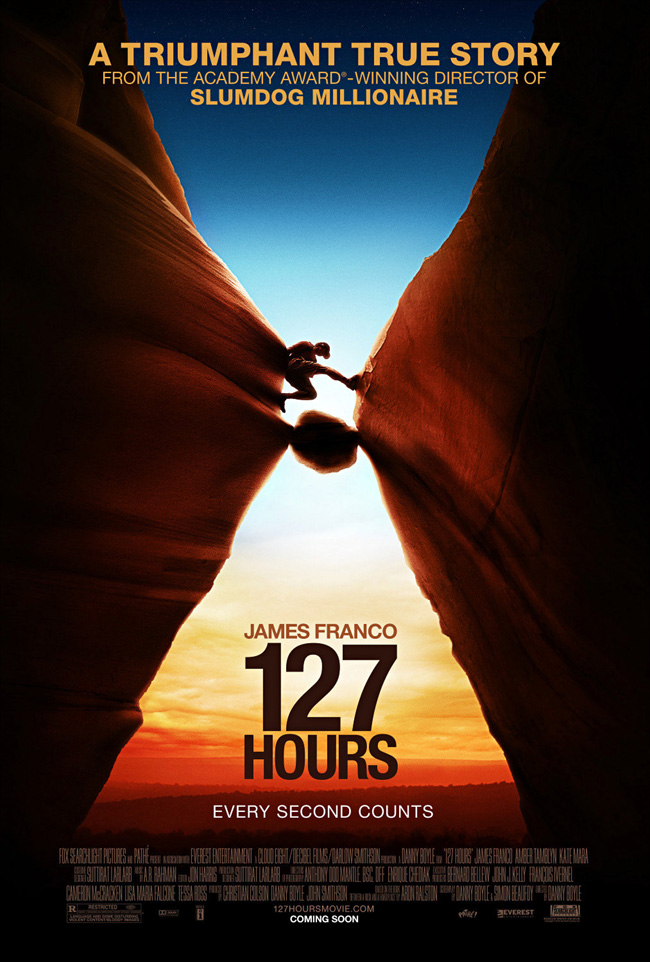
127 Hours
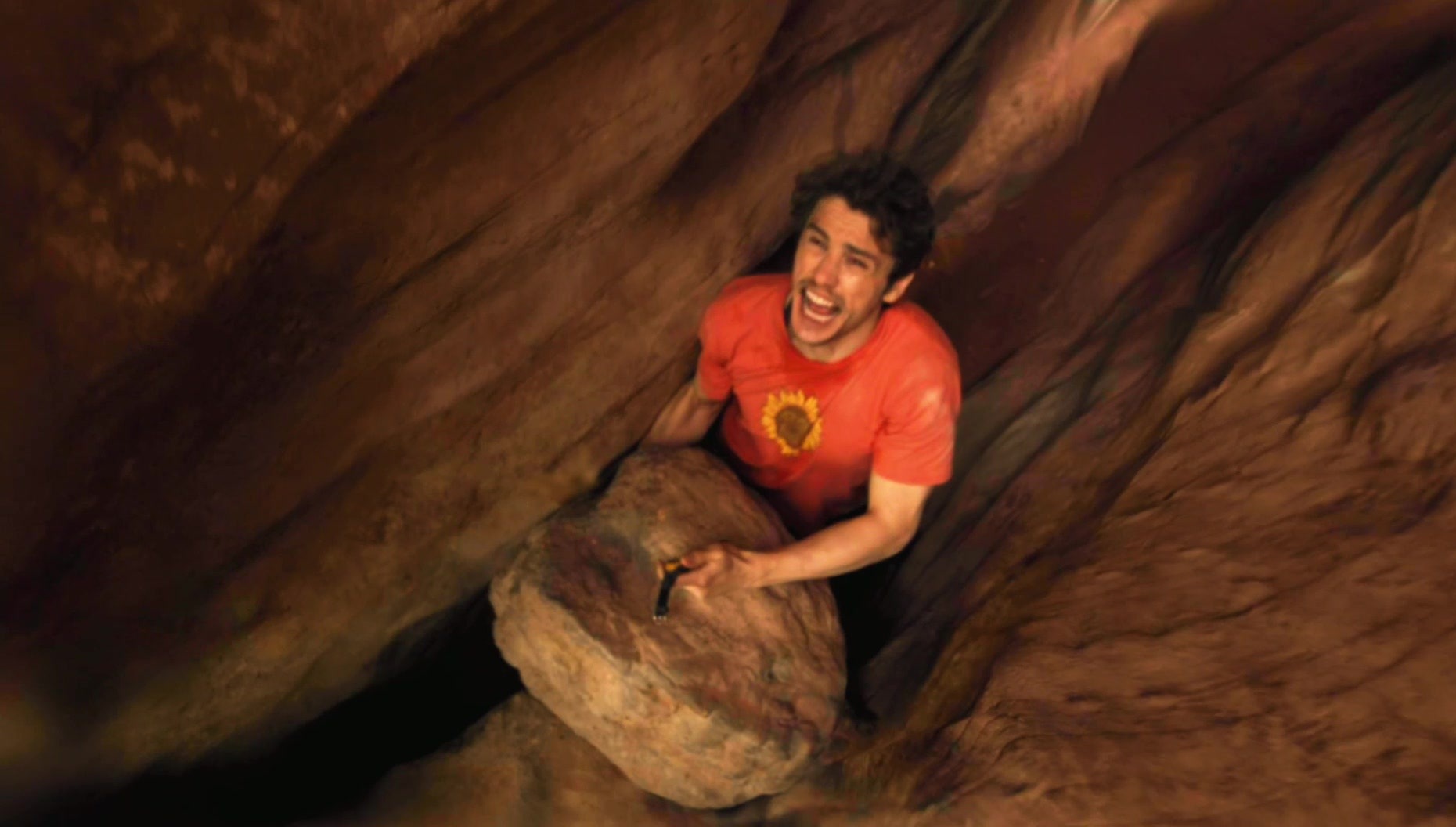
127 Hours (2010) is a Biographical Adventure Thriller, which follows Aron Ralston (James Franco) through his journey as a mountain climber in his spare time. He's a Hero-type character who doesn't especially feel that he needs help from anyone else, and as such, he never really asks, or shares his plans unnecessarily. So it's not out of character when he sets out for a climb for the day without telling anyone where- or that- he's going, and spends a good part of his day with two young women in the mountains. They have a good time together, free falling from between rocks into an underground lake, and Aron promises to come to the girls' party the next night. They're unsure if he'll come, but they hope he will. He sets out alone, climbing around for the rest of the afternoon. He finds himself screwed, however, when having placed his hand on a loose boulder to climb into a long, skinny hole with, it slips, sending him falling, and falls on top of him, pinning his right arm between the wall of the underground cave and the boulder. The rock is crushing his arm, and cutting off the circulation to his fingers. He has only enough food and water to survive a few days, at best. He has no cell-phone, just a watch, camera, digital-recording camera, a headlight, and a multi-gadget device with a dull knife inside. And it'll be 127 hours to go before he reaches any semblance of hope.
The film is based on the autobiography, Between a Rock and a Hard Place by Aron Ralston. The screenplay was co-written, produced, and directed by Danny Boyle. The film has been viewed by Ralston himself since its release, and apart from a scene in the beginning in which Ralston (the character) shows the two girls the underground lake, he said that that movie was as close as it gets to being a Documentary without actually being one, therefore the realness of the film is in high consideration at the moment. Danny Boyle, who also directed the award-winning Slumdog Millionaire, had been excited to do a film version of Ralston's story for years. Simon Beaufry wrote the screenplay for Boyle's treatment, and originally he had Cillian Murphy picked as his top-choice to play Ralston, which didn't happen for whatever reason. Boyle also wanted the entire first half of the movie to be shot without dialogue- which also didn't happen- and I think that's a good thing, because the dialogue helps you get into the character before he's trapped so you can identify with him and be more upset that he's stuck.
My personal opinion of the film was that it was great. Franco's performance is definitely the most notable thing about the film, as it is largely a character piece with only one location (primarily) and you're in his thoughts, memories, and hallucinations a good deal of the time. The film itself is visually well done- the ciematogaphy is interesting. I enjoyed the use of a video-camera for the protagonist, because it gave him an opportunity to talk to us and show us how he's holding up. The climax of the movie was hard to watch, but executed very well. Unfortunately, though I did like this movie, I can't come up with a lot to say about it, simply because there was one main character with one main location, book-ended by the beginning and end. I liked it, but there's not a lot to say other than what's been said.
I do reccomend seeing this movie, it's definitely worth the watch, especially since it's so closely based on the true story of Aron Raston, and to be able to really get a look into what he went through is pretty remarkable. This is not my choice for Best Picture of the Year at the Academy Awards, though I wouldn't be too disappointed if it won, because I can definitely see how it would be a critic's choice, and I hope that everyone gives it a fair chance despite the difficulties of one man and one set.
The film is based on the autobiography, Between a Rock and a Hard Place by Aron Ralston. The screenplay was co-written, produced, and directed by Danny Boyle. The film has been viewed by Ralston himself since its release, and apart from a scene in the beginning in which Ralston (the character) shows the two girls the underground lake, he said that that movie was as close as it gets to being a Documentary without actually being one, therefore the realness of the film is in high consideration at the moment. Danny Boyle, who also directed the award-winning Slumdog Millionaire, had been excited to do a film version of Ralston's story for years. Simon Beaufry wrote the screenplay for Boyle's treatment, and originally he had Cillian Murphy picked as his top-choice to play Ralston, which didn't happen for whatever reason. Boyle also wanted the entire first half of the movie to be shot without dialogue- which also didn't happen- and I think that's a good thing, because the dialogue helps you get into the character before he's trapped so you can identify with him and be more upset that he's stuck.
My personal opinion of the film was that it was great. Franco's performance is definitely the most notable thing about the film, as it is largely a character piece with only one location (primarily) and you're in his thoughts, memories, and hallucinations a good deal of the time. The film itself is visually well done- the ciematogaphy is interesting. I enjoyed the use of a video-camera for the protagonist, because it gave him an opportunity to talk to us and show us how he's holding up. The climax of the movie was hard to watch, but executed very well. Unfortunately, though I did like this movie, I can't come up with a lot to say about it, simply because there was one main character with one main location, book-ended by the beginning and end. I liked it, but there's not a lot to say other than what's been said.
I do reccomend seeing this movie, it's definitely worth the watch, especially since it's so closely based on the true story of Aron Raston, and to be able to really get a look into what he went through is pretty remarkable. This is not my choice for Best Picture of the Year at the Academy Awards, though I wouldn't be too disappointed if it won, because I can definitely see how it would be a critic's choice, and I hope that everyone gives it a fair chance despite the difficulties of one man and one set.
Tuesday, February 8, 2011
The King's Speech
The King's Speech (2010) follows the true story of King George VI- previously the Duke of York (Colin Firth), appointed just before the war with Germany became eminent. The film follows his life as a member of the royal family with his wife, Elizabeth (Helena Bonham Carter) and how he deals with a difficult, controversial matter that greatly interferes with his duties toward the public: he has a speech impediment; a stammer. Elizabeth often tries to force medical help on him out of love, but the doctors- knighted, no less- that see the Duke treat his affliction in all the wrong ways and lead to nothing. In the classified sections, she finds a less well-to-do, Australian immigrant and commoner named Lionel Logue (Geoffrey Rush), who claims he may be able to help the Duke, but only under his roof and his rules. The Duke, who is unattracted to personal situations outside of his family and who has never had a real friend, is turned off by Logue's casual nature at first, and claims it won't work out. Before he goes, Logue has him read a bit of Shakespeare on recording, while listening to classical music through headphones, unable to hear himself. He does so, and Logue lets him keep the record. Days later, when the Duke listens, he discovers that he read perfectly, and returns to therapy- which is exactly what the sessions become. And with his father, King George V's (Mihael Gambon) passing and his brother David's (Guy Pearce) infatuation with an American divorcee- and refusal of the thrown- the Duke must quickly learn to be comfortable in the public's eye. But for a member of the royal family, facing pressure from his peers to exceed expectations, at the same time keeping in all his secrets from the past, how far is he willing to go with this commoner to let loose the person he was born to be from the restraints of his self-inflicted impediment?
The film was written by David Seidler, who also wrote the child's movie, Quest for Camelot, and has recieved two Oscars, nominted for 11, and directed by Tom Hooper- who's been nominated for 15 Oscars and won three of them. Currently, this film has been nominated for 12 Oscars, 14 BAFTAs and seven Golden Globes- and it only just came out three months ago, on December 10, 2010. Seidler himself had a speech impediment as a child, believably brought about by the trauma of living through WW2 and The Holocaust. He was inspired to learn that King George VI overcame one as well, and for his entire childhood, he wanted to write about him. He devoted years of research to the King, and tried hard to build up information on his speech advisor, Lionel Logue- however, the notebooks on his work with the King were denied to Seidler on the Queen Mother's own requests. Seidler abandoned the fascination until he fought a battle with cancer in 2005, to which he proudly returned to it. It was thought that his first version was too soft and cinematic, so he rewrote it as a stage performance. The play was read by a small theatre company in London, and Tom Hooper's mother happened to be in the audience. She promptly called to tell him what his next film would be.
The film was also received well by historical critics- which is no easy feet- but Seidler made adimantly sure that his work portrayed the characters as best as he could. When the diary of Logue came to his attention only nine months before shooting, he went back and reworked it into the script as much as possible. It's claimed that certian characters like Wallis Simpson (Eve Best) and King George V (Michael Gambon) were made out to be more antagonistic in the film than they were in real life. I pose idea, however, that this is a film that is supposed to be in large part portrayed as if we are side by side with the King, trapped in his own mind by his impediment. Often, children- who grow up to be adults- are afraid of certain things, and therefore see them in an antagonistic light. George VI is afraid to be king in the film, therefore, if the film is given to us in his eyes, of course his own father seems antagonistic, as does Wallis Simpson, as she is the very reason his brother David abandons the thrown to force George VI to take over. It's also said that George VI's impediment was exagerated for the film, as well as Logue's character's casual nature. Logue's grandson claimed that he would never have called the King "Bertie" or have sworn in front of him. Never the less, as I do in all matters, I urge this to be viewed for what it is: A Story. Not a Documentary. Don't let something like that spoil your fun. Fall in love with the Logue that David Seidler and Geoffrey Rush created, and was only inspired by the real Lionel Logue.
It is hard to sum up what I did like about this movie, and can only be done by saying what I did not like about this movie. Now that I sit down to write, I must say that it's difficult to come up with anything. It's not as "cinematic" as a film could be, this is true, but I would definitely say that it's as cinematic as this film could be, for sure. This is a film in which the A Story is centered around a man who cannot talk and needs to give speeches... that's definitely an instance of a lot of dialogue- heavy on the dialogue, in fact, and at times requires you to be told instead of shown, however I think it was captured remarkably well, and for a Director, writer, and actors to make a bunch of failed attempts at speech dramatic and emotional, as well as an actual politically motivated speech being the climax of a major movie... that shows talent. Some people struggle with making a BATTLE dramatic, emotional, or even cinematic. They made two men in a booth struggling over two pages of notes the climax of a movie and it worked. Film of the year? The Academy certainly seems to think it might be, and I cannot say that I disagree.
I reccomend this film to everyone- fuck it. EVERYONE. This was a great movie. Some of you might think it's boring- it's character driven without any blood or explosions. There's no puke. There's no piss. There's humor that is few and far between. The costumes are great for the period, but they aren't jarring or attention grabbing. No, this is a film which simply has to be watched because it has to be watched. The acting is superb, as is the writing, and the dramatization has drawn a deep level of respect from me. It's like climbing the Himilayas in flip flops, guys. This film didn't have a let down for me, or anything I want to criticize. But as I said, I know some won't find it as interesting as Inception, without all the themes. But as far as I'm concerned, so far those two are neck-in-neck for me. Inception vs. The King's Speech for Best Film of the Year at this year's Academy Awards.'
The film was written by David Seidler, who also wrote the child's movie, Quest for Camelot, and has recieved two Oscars, nominted for 11, and directed by Tom Hooper- who's been nominated for 15 Oscars and won three of them. Currently, this film has been nominated for 12 Oscars, 14 BAFTAs and seven Golden Globes- and it only just came out three months ago, on December 10, 2010. Seidler himself had a speech impediment as a child, believably brought about by the trauma of living through WW2 and The Holocaust. He was inspired to learn that King George VI overcame one as well, and for his entire childhood, he wanted to write about him. He devoted years of research to the King, and tried hard to build up information on his speech advisor, Lionel Logue- however, the notebooks on his work with the King were denied to Seidler on the Queen Mother's own requests. Seidler abandoned the fascination until he fought a battle with cancer in 2005, to which he proudly returned to it. It was thought that his first version was too soft and cinematic, so he rewrote it as a stage performance. The play was read by a small theatre company in London, and Tom Hooper's mother happened to be in the audience. She promptly called to tell him what his next film would be.
The film was also received well by historical critics- which is no easy feet- but Seidler made adimantly sure that his work portrayed the characters as best as he could. When the diary of Logue came to his attention only nine months before shooting, he went back and reworked it into the script as much as possible. It's claimed that certian characters like Wallis Simpson (Eve Best) and King George V (Michael Gambon) were made out to be more antagonistic in the film than they were in real life. I pose idea, however, that this is a film that is supposed to be in large part portrayed as if we are side by side with the King, trapped in his own mind by his impediment. Often, children- who grow up to be adults- are afraid of certain things, and therefore see them in an antagonistic light. George VI is afraid to be king in the film, therefore, if the film is given to us in his eyes, of course his own father seems antagonistic, as does Wallis Simpson, as she is the very reason his brother David abandons the thrown to force George VI to take over. It's also said that George VI's impediment was exagerated for the film, as well as Logue's character's casual nature. Logue's grandson claimed that he would never have called the King "Bertie" or have sworn in front of him. Never the less, as I do in all matters, I urge this to be viewed for what it is: A Story. Not a Documentary. Don't let something like that spoil your fun. Fall in love with the Logue that David Seidler and Geoffrey Rush created, and was only inspired by the real Lionel Logue.
It is hard to sum up what I did like about this movie, and can only be done by saying what I did not like about this movie. Now that I sit down to write, I must say that it's difficult to come up with anything. It's not as "cinematic" as a film could be, this is true, but I would definitely say that it's as cinematic as this film could be, for sure. This is a film in which the A Story is centered around a man who cannot talk and needs to give speeches... that's definitely an instance of a lot of dialogue- heavy on the dialogue, in fact, and at times requires you to be told instead of shown, however I think it was captured remarkably well, and for a Director, writer, and actors to make a bunch of failed attempts at speech dramatic and emotional, as well as an actual politically motivated speech being the climax of a major movie... that shows talent. Some people struggle with making a BATTLE dramatic, emotional, or even cinematic. They made two men in a booth struggling over two pages of notes the climax of a movie and it worked. Film of the year? The Academy certainly seems to think it might be, and I cannot say that I disagree.
I reccomend this film to everyone- fuck it. EVERYONE. This was a great movie. Some of you might think it's boring- it's character driven without any blood or explosions. There's no puke. There's no piss. There's humor that is few and far between. The costumes are great for the period, but they aren't jarring or attention grabbing. No, this is a film which simply has to be watched because it has to be watched. The acting is superb, as is the writing, and the dramatization has drawn a deep level of respect from me. It's like climbing the Himilayas in flip flops, guys. This film didn't have a let down for me, or anything I want to criticize. But as I said, I know some won't find it as interesting as Inception, without all the themes. But as far as I'm concerned, so far those two are neck-in-neck for me. Inception vs. The King's Speech for Best Film of the Year at this year's Academy Awards.'
Toy Story 3
Toy Story 3 (2010) is a film that most of us probably weren't expecting when we first saw the original, Toy Story, in 1995. I was five-years old- and probably more like Sid than Andy- but the story was adorable, fun and original. Imagine- talking, cinematic toys that didn't want to kill you! In this finale to the series, Andy (John Morris) is 17-years-old and about to embark on the next stage of his life: College. His toys are packed away in the toy-box as they have been for years now, scheming to get played with, but ending up lonely. Andy's mom (Laurie Metcalf) tells him that because he's leaving for school in a week, he needs to pack up his room for College, Attic, or Trash. The toys are concerned that they'll be at the dump in the morning, but Woody (Tom Hanks) assures them that they mean too much to Andy for that. The next day, Andy opens a trash bag and piles them all in- all except Woody, who's miraculously placed in a College box. But the toys aren't on their way to the garbage as they expect- he's carrying them to the attic... but his mother misunderstands due to his predictably bad teenage packing, and puts them on the lawn. Woody follows in fear for their lives, but the toys don't accept being treated as trash, and break free, heading into the garage, where a box of toys for the Sunnyside Daycare waits to be donated. They get inside, refusing to believe that Andy wanted to keep them, and before Woody can convince them, they're packed away. But it's not what they expected. And before they know what they've gotten themselves into, a huggable bear named Lotso (Ned Beaty) has them all under seize in the toddlers room, and has reprogrammed a Zorg-Happy Buzz Lightyear (Tim Allen) to do his bidding in arms.
Toy Story 3 was directed by Lee Unkrich, who also co-directed Toy Story 2, Monsters' Inc, and Finding Nemo. He's also given a credit for writing this story, as is Jogn Lasseter and Andrew Stanton. The screenplay credit actually goes to a fourth man, however, Michael Arndt. Evidently, this movie was a long imagined plan by Disney that was thought may never get made. Back in 2004, Disney claimed ownership over all the original characters, but Pixar held the first right to refuse any sequels that might get made- and they did. The two companies fought for some time over whether or not another would be made, and when the split drew near, Tim Allen said he was on board even if Pixr jumped ship, and they were off with plans for Toy Story 3. This version, however, is not the version we saw in theatres, for that would come many years later. The story involved a Buzz Lightyear malfunctioning, and being sent back to his maker in Tawain where there was an international recall on the product. But, when Pixar was finally bought out by Disney, their chief Animators were put in charge over this project... and scrapped it. But, at long last, they did not scrap the idea of a third movie, and they came up with an idea for it in one weekend, and drew up a treatment, set to be released in 2010. It's every bit as big, delightful, and cute as the very first Toy Story.
The film is one of the features nominated for Best Film of the Year by the Acamdemy Awards. As much as I did enjoy this movie for what it is, there is no way on this Earth that Toy Story 3 was the best film that 2010 had to offer- I'm sorry, but that has to be accurate, or I'm switching jobs. The film is amazing- for what it IS... but in comparison to the epicness of Christopher Nolan's Inception, it doesn't even stand on two feet. Toy Story 3 was written in a weekend... Inception was written in ten years. I didn't complain when Up caught the Academy's attention for the same award last year, because that film was completely original, showed remarkable films for its genre, and despite being geared toward a child audience, had incredible visual effects, and the humor was somehow spot on. It was also incredibly sad. While Toy Story 3 can be a tearjerker for nostalgia purposes, it doesn't even compare fairly to Up as far as I'm concerned, let alone being considered for Best Film of the Year. That's a bad year. It is also up for Best ANIMATED Film, however, which in my opinion, it ought to win.
That being said, I did enjoy Toy Story 3. I thought it was a brilliant, yet fairly simple concept to introduce. Andy and I are about the same age, therefore it makes sense that while I'm in college, the writers may interpret that he would be, as well. Frankly, any other storyline in which Andy was still a child would seem a little flat, just logically speaking. It's daring to take him out of the picture, and it creats an entirely different message to children, and adults- and it definitely worked. The CGI is also wonderful- but, come on Disney and Pixar? I expect nothing less from multi-billionaires. If you've got it, flaunt it. The film isn't as original as the first, but no sequal ever is, and especially considering that it's the THIRD surviving film in a series when most second stories fall flat, that's a credit all by itself. I love that the original voice actors were on board to do this picture, even though it's been years, and it really does add to the nostalgia of the piece, the artwork, and the familiarity. This is definitely a "to own" film, especially if you already have the first two... even if it's on VHS.
In general, I'd reccomend this film to almost anyone. 99% of critics have given it a positive rating. No, I don't think it ought to win film of the year, but I really don't think that was the intention of it. It's a pleasure to watch, it's something I'd like to show to my kids if they ever exist, and it's nice to relive a piece of your past, especially since the film even accknowleges to you that it is the past. This film could have tanked, and I'm very glad that it didn't. It's a wonderful, long-awaited end to a great original series.
The film is one of the features nominated for Best Film of the Year by the Acamdemy Awards. As much as I did enjoy this movie for what it is, there is no way on this Earth that Toy Story 3 was the best film that 2010 had to offer- I'm sorry, but that has to be accurate, or I'm switching jobs. The film is amazing- for what it IS... but in comparison to the epicness of Christopher Nolan's Inception, it doesn't even stand on two feet. Toy Story 3 was written in a weekend... Inception was written in ten years. I didn't complain when Up caught the Academy's attention for the same award last year, because that film was completely original, showed remarkable films for its genre, and despite being geared toward a child audience, had incredible visual effects, and the humor was somehow spot on. It was also incredibly sad. While Toy Story 3 can be a tearjerker for nostalgia purposes, it doesn't even compare fairly to Up as far as I'm concerned, let alone being considered for Best Film of the Year. That's a bad year. It is also up for Best ANIMATED Film, however, which in my opinion, it ought to win.
That being said, I did enjoy Toy Story 3. I thought it was a brilliant, yet fairly simple concept to introduce. Andy and I are about the same age, therefore it makes sense that while I'm in college, the writers may interpret that he would be, as well. Frankly, any other storyline in which Andy was still a child would seem a little flat, just logically speaking. It's daring to take him out of the picture, and it creats an entirely different message to children, and adults- and it definitely worked. The CGI is also wonderful- but, come on Disney and Pixar? I expect nothing less from multi-billionaires. If you've got it, flaunt it. The film isn't as original as the first, but no sequal ever is, and especially considering that it's the THIRD surviving film in a series when most second stories fall flat, that's a credit all by itself. I love that the original voice actors were on board to do this picture, even though it's been years, and it really does add to the nostalgia of the piece, the artwork, and the familiarity. This is definitely a "to own" film, especially if you already have the first two... even if it's on VHS.
Sunday, February 6, 2011
Changeling
The film Changeling (2008) is a Mystery/Drama/Thriller which takes place in the late 1920s - 1930s, Las Angeles, CA. Christine Collins (Angelina Jolie) lives happily as a single mother with her son, Walter (Gattlin Griffith). She is called into work one day when they were supposed to take a trip to the movies, but promises she will be home soon. When she arrives home, her nine-year-old son is missing, and she frantically calls the LAPD for help. Standard procedure is to wait a day... five months later, they think they've found him. Christine is called to the train station by Captain J.J. Jones (Jeffrey Donovan) and excitedly waits. But when the boy steps off the train from Illinois calling her mama, she doesn't recognize him; he's not her son. The LAPD dismisses her as overemotional and too stressed to see correctly. They send the pair home. Even after she discovers that this "returned" boy is tree-inches shorter than Walter, and is circumsized when her own son was not, the corrupt police force still refuses to hear her out. Local minster, Rev. Gustav Briegleb (John Malkovich), seeks out Mrs. Collins to help her. He broadcasts the truth of her story on his radio station when the police refuse to listen to her. Cap. Jones is so angry by this defiance from her that he calls her into the station. He tells her that either she's lying about the whole thing, or she's too confused to know if she's lying or not. Unsure of what to say, Mrs. Collins is powerless against the police force as Cap. Jones calls in hospital staff to have her taken away to a mental institution. Meanwhile, a dedicated cop on the force, Detective Lester Ybarra (Michael Kelly) stumbles upon an illegal immigrant boy from Canada, who recalls to him a tale of multiple child abductions and mass murder he has witnessed by his cousin... identifying Walter Collins as one among the boys he saw taken.
This film was written by J. Michael Straczynski, who did a lot of writing work on the television movie series, Babylon Five. It was directed by the infamous Clint Eastwood, who also directed Million Dollar Baby, True Crime, and Flags of Our Fathers, to name a few. This film is an adaptation based on real events, and Straczynski first heard about this actual LAPD case from a friend. He then spent weeks looking up the actual, historical case file to help him prepare the skript. He based 95% of his first draft on what he drew from 6,000 pages of the case file. The shotting script used was this same first draft. This was the first feature-length film screenplay he had ever written. Though many actors desired the leading role, Clint Eastwood is said to have cast Jolie because he felt that her face fit the period, perfectly. Critics felt the same way, in addition to the marvelous period costumes and set design, and the film was nominated for Best Cinematography, Best Art Direction, and Best Actress in a Leading Role at the Acamdey Awards. It was also recognized by The 2008 Women Film Critics' Circle Awards, winning the Adrienne Shelly Award, and Best Film About Women.
It's no exageration to say that this is an epic period piece, not unlike the sword-and-sandle movies about Troy or Ancient Greece. This movie just happens to be set in near contemporary times, Las Angeles. This film is packed with a great A Story, tons of subpolots, surprises, shocking visual effects, character identification, and a hatred for corruption in the police force. The acting is great in this movie- and I am an avid believer that John Malkovich, when placed into ANY movie, makes it at least watchable, if not buyable, ownable, and lovable. He's the man. The fact that it's based on true events just makes this movie hit home even stronger with its themes, and really helps it to make the startling point about how far corruption can go when unchecked in the police force. I remember Jolie's perfromance, and that of Malkovich the most about the film, but I also greatly enjoyed the set. I felt that the set design was perfect, at times. The suburbs were homey, colorful and rich. The city was nostalgic and beautiful. The mental instituion was gritty, deviant, and horrific, and the characters inside the set were wonderful.
The only complaint I have about the movie would take a Spoiler to entirely explain, so I will simply say that in the end of the film, a few things are loose where they could be tighter. A murdered is brought in for trial toward the end of the film, and he mentions things that start a new quest for the protagonist... but then you find out he might have been lying- might not have been lying, and that part is just a little bit... forced. If not forced, then useless. It's like being told there's a rock under the tree, and you look, and there's not one. And then he tells you that he moved it. But to where? It's sortof a big reach around. But the rest of the movie is so great that you hardly take it into consideration when you look back on it.
I definitely enjoyed this movie. I am a big fan of mysteries and dramas, and I love Angelina. I think her face and body are interesting, unique, and she's one of those Jared Leto-esc actors who is willing to do odd and sometimes scrupulous things to his/her body to make a statement for a role. I like her for that. I love period pieces as well, and I was never wondering throughout the movie whether or not I was in the 1920s or 30s. The movie was very polished and well- done. Frankly, I was surprised that they didn't WIN those Academy Awards they were nominated for. But, as I say every year, I don't know who the fuck votes for those things, but it sure aint me.
This film was written by J. Michael Straczynski, who did a lot of writing work on the television movie series, Babylon Five. It was directed by the infamous Clint Eastwood, who also directed Million Dollar Baby, True Crime, and Flags of Our Fathers, to name a few. This film is an adaptation based on real events, and Straczynski first heard about this actual LAPD case from a friend. He then spent weeks looking up the actual, historical case file to help him prepare the skript. He based 95% of his first draft on what he drew from 6,000 pages of the case file. The shotting script used was this same first draft. This was the first feature-length film screenplay he had ever written. Though many actors desired the leading role, Clint Eastwood is said to have cast Jolie because he felt that her face fit the period, perfectly. Critics felt the same way, in addition to the marvelous period costumes and set design, and the film was nominated for Best Cinematography, Best Art Direction, and Best Actress in a Leading Role at the Acamdey Awards. It was also recognized by The 2008 Women Film Critics' Circle Awards, winning the Adrienne Shelly Award, and Best Film About Women.
It's no exageration to say that this is an epic period piece, not unlike the sword-and-sandle movies about Troy or Ancient Greece. This movie just happens to be set in near contemporary times, Las Angeles. This film is packed with a great A Story, tons of subpolots, surprises, shocking visual effects, character identification, and a hatred for corruption in the police force. The acting is great in this movie- and I am an avid believer that John Malkovich, when placed into ANY movie, makes it at least watchable, if not buyable, ownable, and lovable. He's the man. The fact that it's based on true events just makes this movie hit home even stronger with its themes, and really helps it to make the startling point about how far corruption can go when unchecked in the police force. I remember Jolie's perfromance, and that of Malkovich the most about the film, but I also greatly enjoyed the set. I felt that the set design was perfect, at times. The suburbs were homey, colorful and rich. The city was nostalgic and beautiful. The mental instituion was gritty, deviant, and horrific, and the characters inside the set were wonderful.
The only complaint I have about the movie would take a Spoiler to entirely explain, so I will simply say that in the end of the film, a few things are loose where they could be tighter. A murdered is brought in for trial toward the end of the film, and he mentions things that start a new quest for the protagonist... but then you find out he might have been lying- might not have been lying, and that part is just a little bit... forced. If not forced, then useless. It's like being told there's a rock under the tree, and you look, and there's not one. And then he tells you that he moved it. But to where? It's sortof a big reach around. But the rest of the movie is so great that you hardly take it into consideration when you look back on it.
I definitely enjoyed this movie. I am a big fan of mysteries and dramas, and I love Angelina. I think her face and body are interesting, unique, and she's one of those Jared Leto-esc actors who is willing to do odd and sometimes scrupulous things to his/her body to make a statement for a role. I like her for that. I love period pieces as well, and I was never wondering throughout the movie whether or not I was in the 1920s or 30s. The movie was very polished and well- done. Frankly, I was surprised that they didn't WIN those Academy Awards they were nominated for. But, as I say every year, I don't know who the fuck votes for those things, but it sure aint me.
Thursday, February 3, 2011
Quills
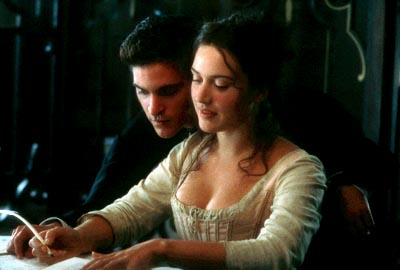
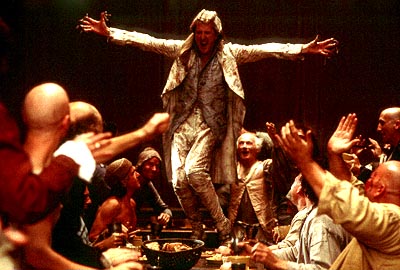
The film Quills (2000) is a biographical drama, inspired by the life accomplishments, and imprisonments of The Marquis de Sade, a french writer during the 18th century well-known for his graphically sexual and violent stories. A little too well-known, the stories (and some sexual crimes as well) get him into some trouble with the government, and he is faced with the choice between life in a prison or an asylum. His wife opps for the asylum, and that's where he comfortably stays in an ornate room, working on plenty of fresh work for the read. Madeline (Kate Winslet) a chambermaid in the asylum, sees the potential in de Sade, who is an easily loved character despite his perverted nature, and helps sneak his manuscripts to a horseman outside the asylum walls to be published. When Justine, his latest novel, appears in the hands of Napolean however, he orders de Sade to be shot. He settles for traditionalist Dr. Royer-Collard (Michael Caine), who enjoys trying out his new and sadistic "treatments" on patients to achieve moral order, to come and see over the aslym currently run by The Abbe du Coulmier (Joaquin Phoenix). Abbe is a naive, young man of God who believes de Sade is his friend and will comply with the new doctor, but when he does not, he is forced to take serious measures; measures that only push de Sade further into the beastish part of his personality, and pit science against religion- doctor against patient- censorship against freedom- for France.
The screenplay for Quills was written by Doug Wright, who also wrote the Opie-Award winning play that this film is based on. It was directed by Philip Kaufman, who is most famously known for his character work in the Indiana Jones movies. He used The Marquis de Sade: A Life, written by Neil Schaeffer, as a loose reference for his work, and he was nominated for a Golden Globe for Best Screenplay for this film. The sets were built in modern day Oxfordshire, Befordshire, and London and made to look like 18th century France- a feet which is not always easy to achieve, and acquired an Oscar nomination for Art Direction. Jacqueline West was in charge of the period-piece costumes on the set, and reportedly told Winslet to reference Léopold Boilly's "Woman Ironing" to get a feel for her character. She did, and claimed that it strongly influenced her role. West was also nominated for an
Oscar in costume design.
The play was received well by critics, as was the film, but is often criticized for being historically inaccurate. Neil Schaeffer himself (who wrote The Marquis de Sade: A Life, and then wrote a review of the film) detailed these inaccuracies in full, pointing out errors in character, interpretation, and even criticizing his own impression of the character. Now, I watched the film... and I acquired certain opinions of my own. The facts that were perported wrong in the film were changed to alter the cinematic quality of the film. If they had been left as they actually happened, the film would not have been as dramatic, and it is classified as a friggen Drama. Secondly, I feel that it's a bit rude to hold the creator accountable for the impressions you got of people detailed in the film. Personally, I believe that most people get a different sense of a particular character based on their own feelings on subjects, their education, experiences, and so forth. Schaeffer claims that the film leaves you with the impression that de Sade wrote to oppose censorship- which I did not get, at ALL. He is definitely set up as a character who believes what he's saying. He's not just doing it to be popular- he really is a dirty old man, and he's pushing the boundaries of himself and the world, which is exactly what I thought after watching the film, and exactly what Schaeffer claims he was like. So... I don't think the writers can really be faulted there, as that seems to be on a person-to-person basis. However, I will agree with Schaeffer on one point: one should always judge the film as a seperate source than the real person, as well as a seperate source from the play, because that's exactly what it is, and it will help you to enjoy all the different stories in their own ways if you approach them that way.
Most notable about this film, I felt, was Geoffrey Rush's portrayal of de Sade. I don't find Rush particularly attractive, and he's considerably older than me in this film, but... damn, the man was still sexy. He's gleeful, and daring, defiant, rude, crude, sassy, stuck-up, selfish, insanely intellegent- just insane in general- addicted to the creation of the bold, and bewilderingly sexy, somehow. I like to compare him to Russell Brand's approach to movement: they both move with a sophistication, a confidence, and an elegance that attracts the eye and ears, and they are also both very good speakers with very distinct voices. Not to mention that when de Sade opens his mouth, the insatiable perverse and witty things that come out keep you laughing in shock and with humor, at the same time. He's so easy to fall in love with- and his wife puts it quite clearly by saying that, "His cruelest trick was making me fall in love with him,"- that by the time it gets to his character low point and he's sunk as far as you hope he can go, you feel terrible for him, and almost embarrassed to see him so exposed. But he really pushes the barrier at times, making you dislike him as well, so you know he does deserve punishment, but you just don't. want. to. see. it. His performance was nominated for an Oscar as Actor in a Leading Role, and a Golden Globe as Best Actor in a Drama.
I really enjoyed this movie, despite the inaccuracies, and I reccomend it to anyone who likes period pieces, asylums, any of the leading actors as they all did incredible jobs, or even just dramas in general. This film works extremely well in what it does, and I'm sad on its behalf that it wasn't more popular when it came out. It's gory at times, emotional, steamy, romantic, frightening, utterly disturbing, but always completely outrageous and impossible to turn off. But don't watch it before bed, on my reccomendation. I'm not squeamish, but there are some visuals at the end that stick with you, and it makes it a little hard to fall asleep with that in your head.
The screenplay for Quills was written by Doug Wright, who also wrote the Opie-Award winning play that this film is based on. It was directed by Philip Kaufman, who is most famously known for his character work in the Indiana Jones movies. He used The Marquis de Sade: A Life, written by Neil Schaeffer, as a loose reference for his work, and he was nominated for a Golden Globe for Best Screenplay for this film. The sets were built in modern day Oxfordshire, Befordshire, and London and made to look like 18th century France- a feet which is not always easy to achieve, and acquired an Oscar nomination for Art Direction. Jacqueline West was in charge of the period-piece costumes on the set, and reportedly told Winslet to reference Léopold Boilly's "Woman Ironing" to get a feel for her character. She did, and claimed that it strongly influenced her role. West was also nominated for an
Oscar in costume design.
The play was received well by critics, as was the film, but is often criticized for being historically inaccurate. Neil Schaeffer himself (who wrote The Marquis de Sade: A Life, and then wrote a review of the film) detailed these inaccuracies in full, pointing out errors in character, interpretation, and even criticizing his own impression of the character. Now, I watched the film... and I acquired certain opinions of my own. The facts that were perported wrong in the film were changed to alter the cinematic quality of the film. If they had been left as they actually happened, the film would not have been as dramatic, and it is classified as a friggen Drama. Secondly, I feel that it's a bit rude to hold the creator accountable for the impressions you got of people detailed in the film. Personally, I believe that most people get a different sense of a particular character based on their own feelings on subjects, their education, experiences, and so forth. Schaeffer claims that the film leaves you with the impression that de Sade wrote to oppose censorship- which I did not get, at ALL. He is definitely set up as a character who believes what he's saying. He's not just doing it to be popular- he really is a dirty old man, and he's pushing the boundaries of himself and the world, which is exactly what I thought after watching the film, and exactly what Schaeffer claims he was like. So... I don't think the writers can really be faulted there, as that seems to be on a person-to-person basis. However, I will agree with Schaeffer on one point: one should always judge the film as a seperate source than the real person, as well as a seperate source from the play, because that's exactly what it is, and it will help you to enjoy all the different stories in their own ways if you approach them that way.
Most notable about this film, I felt, was Geoffrey Rush's portrayal of de Sade. I don't find Rush particularly attractive, and he's considerably older than me in this film, but... damn, the man was still sexy. He's gleeful, and daring, defiant, rude, crude, sassy, stuck-up, selfish, insanely intellegent- just insane in general- addicted to the creation of the bold, and bewilderingly sexy, somehow. I like to compare him to Russell Brand's approach to movement: they both move with a sophistication, a confidence, and an elegance that attracts the eye and ears, and they are also both very good speakers with very distinct voices. Not to mention that when de Sade opens his mouth, the insatiable perverse and witty things that come out keep you laughing in shock and with humor, at the same time. He's so easy to fall in love with- and his wife puts it quite clearly by saying that, "His cruelest trick was making me fall in love with him,"- that by the time it gets to his character low point and he's sunk as far as you hope he can go, you feel terrible for him, and almost embarrassed to see him so exposed. But he really pushes the barrier at times, making you dislike him as well, so you know he does deserve punishment, but you just don't. want. to. see. it. His performance was nominated for an Oscar as Actor in a Leading Role, and a Golden Globe as Best Actor in a Drama.
Wednesday, February 2, 2011
Salt
The film Salt (2010) is a suspenseful Action/Thriller in which Evelyn Salt a.k.a. Nathasha Chenkov (Angelina Jolie) works for the CIA by helping uncover Russian moles/spies in the government. On the anniversary of her marriage to Arachnologist Mike Krause (August Diehl), a older Russian man comes forward with information on a Russian Sleeper Spy who's going to kill the President of Russia in just a few days time. The name he gives is "Evelyn Salt." Salt, swearing she is not who he says she is, knows that when a spy is sought after, the people seeking them find their covers as well- their families. She frantically calls her husband with no answer, and attempts to flee her coworkers and boss, Ted Winter (Liev Schreiber) and man who suspects her of foul play most, Peabody (Chiwetel Ejiofor). After a grueling chase, her husband still missing, she leaves us all with a question: Is she a spy, or not? And if so, where do her loyalties lie?
This film was written by Kurt Wimmer as an original screenplay, who also wrote Law Abiding Citizen (2009) and Ultraviolet (2006). It was directed by Phillip Noyce, a somewhat less well-known name. An interesting fact about this movie is that it was originally written to be starred in by Tom Cruise, and was re-written to star Angelina Jolie, instead. It was orignally titled, The Far-Reaching Philosophy of Edwin A. Salt, later shortened to just Edwin A. Salt when picked up by Columbia Pictures in 2007. Tom Cruise was attracted to the role, but ultimately turned it down when he felt the lead role too closely resembled his role in Mission Impossible. Angelia Jolie, to her credit, had previously turned down a role as a James Bond girl, saying she would, "rather play Bond himself." This is what led Noyce to her, and drastically changed the screenplay that Wimmer had produced, but not without his permission, and certainly not the attitudes and themes it held.
Being an action movie, this film is certainly notable for its coreographed violence, intriguing fighting tactics, and creative ways of "getting away." There is more than one remarkable scene in the movie in which Jolie performs quite well, and the camera loves her. But this movie also features some amazing prostetic work which is done to Jolie's face to make her look like a Russian man in Act 2. Her hair is cut, and- similar to the work done in White Chicks (but of COURSE more realistic)- her face, ears, and hands are changed before us. However, we can still tell its her because of her distinguishing eyes. The work is very well done. The soundtrack is also extremely fitting to the work being done. It was not written by any one person, but is rather a collection of artists. However, it does feel remotely similar to the work of composer Hans Zimmer. If you are familiar with and enjoy him, then you will also most likely enjoy this.
This film has three versions: The Theatrical Version, The Director's Cut, and The Extended Version. As not to include spoilers, I will not state the differences between them except to say that The Theatrical version is 100 minutes long, The Director's Cut is 104 minutes long, and The Extended Version is 101 minutes long, with a different ending than the first two and rearranged scenes throughout for a different feel. My personal suggestion is ALWAYS to go with The Director's cut, as it's the material in the rawest form possible as it was conceived by the authors, without the generalization and censorship of producers and the like.
Overall, I did like this movie. The action was enticing, the costumes were fitting- Angelia Jolie is fucking beautiful, and also makes a very cute tom-boy- and the whole movie moves very quickly. There are twists and turns and surprises for the audience, even if you try to figure her out. The only complaint I have is that I wish I knew more about her character, which is less common in an action movie, but I wanted to have a bit more of a connection to her as the protagonist. Still, definitely keeps you watching.
This film was written by Kurt Wimmer as an original screenplay, who also wrote Law Abiding Citizen (2009) and Ultraviolet (2006). It was directed by Phillip Noyce, a somewhat less well-known name. An interesting fact about this movie is that it was originally written to be starred in by Tom Cruise, and was re-written to star Angelina Jolie, instead. It was orignally titled, The Far-Reaching Philosophy of Edwin A. Salt, later shortened to just Edwin A. Salt when picked up by Columbia Pictures in 2007. Tom Cruise was attracted to the role, but ultimately turned it down when he felt the lead role too closely resembled his role in Mission Impossible. Angelia Jolie, to her credit, had previously turned down a role as a James Bond girl, saying she would, "rather play Bond himself." This is what led Noyce to her, and drastically changed the screenplay that Wimmer had produced, but not without his permission, and certainly not the attitudes and themes it held.
This film has three versions: The Theatrical Version, The Director's Cut, and The Extended Version. As not to include spoilers, I will not state the differences between them except to say that The Theatrical version is 100 minutes long, The Director's Cut is 104 minutes long, and The Extended Version is 101 minutes long, with a different ending than the first two and rearranged scenes throughout for a different feel. My personal suggestion is ALWAYS to go with The Director's cut, as it's the material in the rawest form possible as it was conceived by the authors, without the generalization and censorship of producers and the like.
Overall, I did like this movie. The action was enticing, the costumes were fitting- Angelia Jolie is fucking beautiful, and also makes a very cute tom-boy- and the whole movie moves very quickly. There are twists and turns and surprises for the audience, even if you try to figure her out. The only complaint I have is that I wish I knew more about her character, which is less common in an action movie, but I wanted to have a bit more of a connection to her as the protagonist. Still, definitely keeps you watching.
Subscribe to:
Posts (Atom)